• Recommendation Systems (4): CTR Prediction and Click-Through Rate Modeling

    permalink: "en/recommendation-systems-4-ctr-prediction/" date: 2024-05-17 15:45:00 tags: - Recommendation Systems - CTR Prediction - Click-Through Rate categories: Recommendation Systems mathjax: true--- When you scroll through your social media feed, click on a product recommendation, or watch a suggested video, you're interacting with one of the most critical components of modern recommendation systems: the CTR (Click-Through Rate) prediction model. These models answer a deceptively simple question: "What's the probability this user will click on this item?" But behind this simplicity lies a complex machine learning challenge that directly impacts billions of dollars in revenue for platforms like Facebook, Google, Amazon, and Alibaba.

    CTR prediction sits at the heart of the ranking stage in recommendation systems. After candidate generation retrieves thousands of potential items, CTR models score each candidate to determine the final ranking order. A 1% improvement in CTR prediction accuracy can translate to millions of dollars in additional revenue for large-scale platforms. This makes CTR prediction one of the most researched and optimized problems in machine learning.

    This article takes you on a journey through the evolution of CTR prediction models, from the foundational Logistic Regression baseline to state-of-the-art deep learning architectures like DeepFM, xDeepFM, DCN, AutoInt, and FiBiNet. We'll explore not just how these models work mathematically, but why they were designed the way they were, what problems they solve, and how to implement them from scratch. Along the way, we'll cover feature engineering techniques, training strategies, and practical considerations that separate academic prototypes from production-ready systems.

    Whether you're building a recommendation system for the first time or optimizing an existing one, understanding CTR prediction models is essential. These models have evolved dramatically over the past decade, incorporating insights from factorization machines, deep learning, attention mechanisms, and feature interaction modeling. By the end of this article, you'll have a comprehensive understanding of the field and the practical skills to implement these models yourself.
  • Recommendation Systems (3): Deep Learning Foundation Models

    permalink: "en/recommendation-systems-3-deep-learning-basics/" date: 2024-05-12 10:00:00 tags: - Recommendation Systems - Deep Learning - Neural Networks categories: Recommendation Systems mathjax: true--- In 2016, Google introduced the Wide & Deep model in Google Play's recommendation system, marking the formal entry of deep learning into the mainstream of recommendation systems. Prior to this, recommendation systems primarily relied on traditional methods such as matrix factorization and collaborative filtering. While these methods achieved success in competitions like the Netflix Prize, they had significant limitations: difficulty handling high-dimensional sparse features, inability to capture nonlinear relationships, and heavy reliance on manual feature engineering.

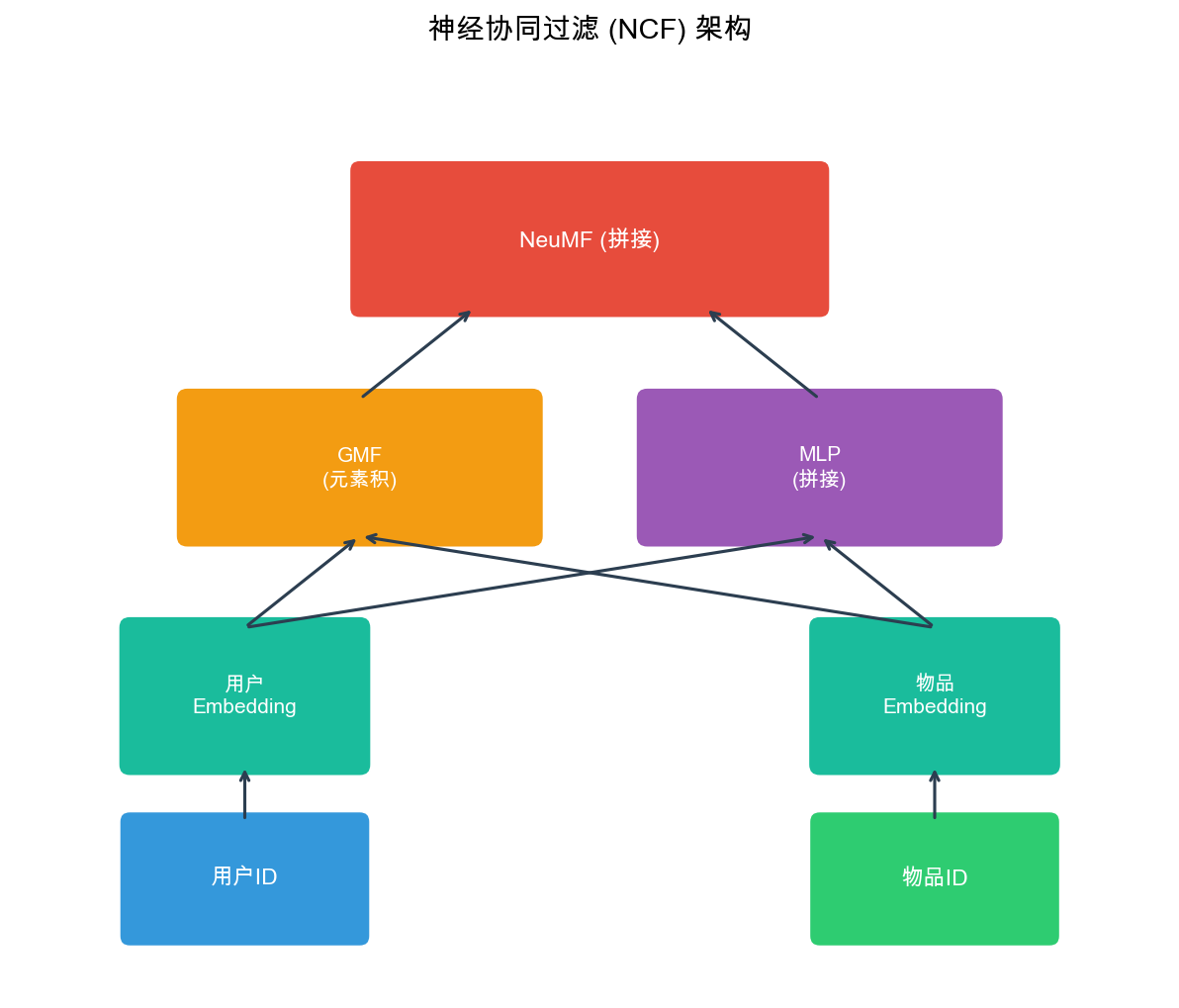
    Deep learning has brought revolutionary changes to recommendation systems. Through multi-layer neural networks, we can automatically learn representations (Embeddings) of users and items, capture complex interaction patterns, handle multimodal features, and train end-to-end on large-scale data. From NCF (Neural Collaborative Filtering) to AutoEncoder-based recommendations, from Wide & Deep to DeepFM, deep learning models have demonstrated powerful capabilities across all stages of recommendation systems, including CTR prediction, recall, and ranking.

    This article provides an in-depth exploration of the core concepts, mainstream models, and implementation details of deep learning recommendation systems. We'll start by understanding the essence of Embeddings and why they're so important; then dive deep into classic models like NCF, AutoEncoders (CDAE/VAE), and Wide & Deep; discuss feature engineering and training techniques; and finally present 10+ complete code implementations and 10+ Q&A sections addressing common questions. Whether you're new to recommendation systems or want to systematically understand deep learning recommendation models, this article will help you build a complete knowledge framework.

  • Recommendation Systems (13): Fairness, Debiasing, and Explainability

    permalink: "en/recommendation-systems-13-fairness-explainability/" date: 2024-07-01 09:00:00 tags: - Recommendation Systems - Fairness - Explainability categories: Recommendation Systems mathjax: true--- When Netflix recommends "The Crown" to a user who watched "The Queen," the system might appear to understand historical dramas, but hidden biases could be at play: are historical dramas featuring women being systematically under-recommended? When Amazon suggests products, are certain demographics receiving lower-quality recommendations? These questions highlight two critical challenges in modern recommendation systems: fairness and explainability. As recommendation systems increasingly influence what we watch, buy, and discover, ensuring they are fair (treating all users and items equitably) and explainable (providing transparent reasoning for recommendations) has become not just an ethical imperative but a business necessity.

    Fairness in recommendation systems addresses systematic biases that can disadvantage certain user groups or item categories. These biases can emerge from imbalanced training data, algorithmic design choices, or feedback loops that amplify existing inequalities. Explainability, on the other hand, addresses the "black box" problem: users and stakeholders need to understand why recommendations are made, not just accept them blindly. Together, fairness and explainability form the foundation of trustworthy recommendation systems that users can rely on and regulators can audit.

    This article provides a comprehensive exploration of fairness and explainability in recommendation systems, covering bias types and their sources, causal inference foundations for understanding recommendation effects, counterfactual reasoning for fair recommendation, CFairER (Counterfactual Fairness in Recommendation), debiasing methods (pre-processing, in-processing, and post-processing), explainable recommendation techniques, attention visualization, LIME and SHAP for model interpretation, trust-building strategies, and practical implementations with 10+ code examples and detailed Q&A sections addressing common challenges and design decisions.

  • Recommendation Systems (1): Fundamentals and Core Concepts

    permalink: "en/recommendation-systems-1-fundamentals/" date: 2024-05-02 09:00:00 tags: - Recommendation Systems - Collaborative Filtering - Introduction categories: Recommendation Systems mathjax: true --- Imagine opening Netflix and seeing a carefully curated row of shows that perfectly match your taste, or scrolling through Amazon and discovering products you didn't even know you needed. Behind these experiences lies one of the most commercially successful applications of machine learning: recommendation systems. From e-commerce giants like Amazon generating 35% of their revenue through recommendations, to streaming platforms like Spotify keeping users engaged with personalized playlists, recommendation systems have become the invisible force driving modern digital experiences.

    But what exactly makes a good recommendation system? How do these systems learn your preferences without explicitly asking you? And more importantly, how can you build one from scratch? This article takes you from the fundamental concepts to practical implementations, covering the three major paradigms (collaborative filtering, content-based filtering, and hybrid approaches), evaluation metrics that matter in production, real-world system architectures, and the core challenges that every recommendation engineer must face.

    Whether you're a data scientist looking to understand the theory, a software engineer tasked with building a recommender, or simply curious about how Netflix knows you better than your friends do, this guide provides the foundation you need. We'll explore not just the "what" and "how," but critically, the "why" – understanding the trade-offs, failure modes, and design decisions that separate academic toys from production-grade systems handling billions of users.

  • Recommendation Systems (8): Knowledge Graph-Enhanced Recommendation

    permalink: "en/recommendation-systems-8-knowledge-graph/" date: 2024-06-06 16:00:00 tags: - Recommendation Systems - Knowledge Graph - KG-enhanced categories: Recommendation Systems mathjax: true --- When you search for "The Dark Knight" on a movie recommendation platform, the system doesn't just know you watched it — it understands that Christian Bale played Batman, Christopher Nolan directed it, it's part of the Batman trilogy, and it's similar to other superhero films. This rich semantic understanding comes from knowledge graphs, structured representations that encode entities (movies, actors, directors) and their relationships (acted_in, directed_by, similar_to) as a graph. Knowledge graph-enhanced recommendation systems leverage these semantic relationships to provide more accurate, explainable, and diverse recommendations, especially for cold-start items and users with sparse interaction histories.

    Knowledge graphs transform recommendation from pure pattern matching to semantic reasoning. Traditional collaborative filtering methods struggle when items have few interactions, but knowledge graphs provide rich auxiliary information: if a new movie shares actors or directors with movies you've enjoyed, the system can confidently recommend it even without historical interaction data. This article provides a comprehensive exploration of knowledge graph-enhanced recommendation systems, covering knowledge graph fundamentals, their role in recommendation, propagation-based methods like RippleNet, graph convolutional approaches (KGCN), attention mechanisms (KGAT, HKGAT), collaborative knowledge embedding (CKE), recent advances in RecKG, and practical implementations with 10+ code examples and detailed Q&A sections.

  • Transfer Learning (7): Zero-Shot Learning

    Zero-Shot Learning (ZSL) is a machine learning paradigm capable of recognizing classes never seen during training. Humans possess powerful zero-shot learning abilities — even without seeing a zebra before, we can recognize it through descriptions like "looks like a horse but with black and white stripes." Lampert et al.'s pioneering 2009 paper "Learning to Detect Unseen Object Classes" introduced this capability to computer vision, launching zero-shot learning research. Zero-shot learning has important applications in long-tail distributions, rapid new class adaptation, and low-resource scenarios, but also faces many challenges like semantic gaps, domain shift, and hubness problems.

    This article derives the mathematical foundations of zero-shot learning from first principles, explains construction of attribute representations and semantic embedding spaces, details compatibility function design and optimization, deeply analyzes principles of traditional discriminative ZSL and modern generative ZSL (f-CLSWGAN, f-VAEGAN, etc.), introduces bias calibration methods for generalized zero-shot learning (GZSL), and provides complete code implementations (including attribute learning, visual-semantic mapping, conditional generative models, etc.). We'll see that zero-shot learning essentially learns a cross-modal mapping from visual space to semantic space, bridging seen and unseen classes through auxiliary information (attributes, word embeddings, etc.).

  • Mathematical Derivation of Machine Learning (5): Linear Regression

    In 1886, Francis Galton discovered a peculiar phenomenon while studying the relationship between parent and child heights: children of extremely tall or short parents tended to have heights closer to the average. He coined the term "regression toward the mean," which is the origin of the word "regression." However, the true power of linear regression lies not in statistical description, but in being the mathematical foundation for almost all machine learning algorithms — from neural networks to support vector machines, all can be viewed as generalizations of linear regression.

    The essence of linear regression is finding the optimal hyperplane in the data space. This seemingly simple problem conceals deep connections among linear algebra, probability theory, and optimization theory. This chapter provides a complete mathematical derivation of linear regression from multiple perspectives.

  • Mathematical Derivations in Machine Learning (7): Decision Trees

    Decision trees are one of the most intuitive machine learning models — like the human decision-making process, they progressively narrow down the answer range through a series of "yes or no" questions. But behind them lie profound foundations in information theory and probability theory: How to choose the optimal split point? How to avoid overfitting? How to handle continuous features and missing values? This chapter will systematically derive the mathematical principles of decision trees, from the definition of entropy to the details of ID3, C4.5, and CART algorithms, from pruning theory to the ensemble ideas of random forests, comprehensively revealing the inner logic of tree models.

  • Machine Learning Math Derivations (15): Hidden Markov Models

    Hidden Markov Models (HMM) are classical tools for sequence modeling - when we observe a series of visible outputs, how can we infer the underlying hidden state sequence? From speech recognition to part-of-speech tagging, from bioinformatics to financial time series, HMMs solve three fundamental problems (probability computation, learning, and prediction) through elegant dynamic programming algorithms. This chapter systematically derives the mathematical principles of forward-backward algorithms, optimal path solving with the Viterbi algorithm, and the EM framework implementation of the Baum-Welch algorithm.

  • Machine Learning Math Derivations (16): Conditional Random Fields

    Conditional Random Fields (CRF) are discriminative models for sequence labeling - unlike HMMs, CRFs directly model the conditional probabilityrather than the joint probability, thereby avoiding the observation independence assumption and allowing flexible use of overlapping features. From named entity recognition to part-of-speech tagging, from information extraction to image segmentation, CRFs achieve optimal performance in sequence modeling through clever undirected graph structures and feature engineering. This chapter systematically derives potential functions of linear-chain CRFs, partition functions, forward-backward algorithms, gradient computation for parameter learning, and LBFGS optimization.