
Two pointers is one of the most elegant techniques in interview
algorithms: by cleverly maintaining the positional relationship between
two pointers, you can reduce brute-force
Series Navigation
📚 LeetCode Algorithm Masterclass Series (10 Parts): 1. Hash Tables (Two Sum, Longest Consecutive, Group Anagrams) 2. → Two Pointers (Collision, Fast-Slow, Sliding Window) ← You are here 3. Linked List Operations (Reverse, cycle detection, merge) 4. Binary Tree Traversal & Recursion (Inorder/Preorder/Postorder, LCA) 5. Dynamic Programming Intro (1D/2D DP, state transition) 6. Backtracking Algorithms (Permutations, combinations, pruning) 7. Binary Search Advanced (Integer/Real binary search, answer binary search) 8. Stack & Queue (Monotonic stack, priority queue, deque) 9. Graph Algorithms (BFS/DFS, topological sort, union-find) 10. Greedy & Bit Manipulation (Greedy strategies, bitwise tricks)
Core Concept of Two Pointers
Why Do We Need Two Pointers?
Scenario: Find two numbers in a sorted array that sum to a target value.
Brute Force: Two nested loops enumerate all pairs
→
- Left pointer points to smallest value
- Right pointer points to largest value
- If sum too small, move left pointer right (increase sum)
- If sum too large, move right pointer left (decrease sum)
- Complexity reduces to
Three Core Patterns
| Pattern | Pointer Relationship | Typical Scenario | Example Problems |
|---|---|---|---|
| Collision Pointers | Move from both ends toward center | Sorted array, palindrome check | Two Sum II, Container With Most Water |
| Fast-Slow Pointers | Move at different speeds | Linked list cycle detection, find middle | Linked List Cycle, Happy Number |
| Sliding Window | Maintain fixed/dynamic interval | Subarray/substring problems | Longest Substring Without Repeating, Minimum Window Substring |
Pattern 1: Collision Pointers
Core Characteristics
- Left pointer starts from beginning
- Right pointer starts from end
- Pointers converge, moving toward each other until they meet
- Usually used for sorted arrays or problems requiring consideration of both ends
Real-World Analogy
Imagine you're at a bookstore with a fixed budget for two books:
- You start from the cheapest shelf
- Your friend starts from the most expensive shelf
- If total too cheap, you move toward expensive books
- If total too expensive, friend moves toward cheap books
- Eventually you meet at shelves that exactly fit your budget
LeetCode 11: Container With Most Water
Problem Analysis
Core Challenge: The key difficulty lies in finding
the container with maximum area in
Solution Approach: Use collision pointers (converging from both ends). The key insight is a greedy strategy: always move the shorter side. Since area is determined by the shorter edge, moving the longer edge only reduces width without increasing height, so area must decrease; moving the shorter edge reduces width but may encounter a taller edge, so area may increase. This strategy ensures we don't miss the optimal solution.
Complexity Analysis: - Time
Complexity:
Key Insight: The correctness of the greedy strategy
is based on proof by contradiction: if the optimal solution is
Problem Statement
Given
Example:
- Input:
height = [1,8,6,2,5,4,8,3,7] - Output:
49 - Explanation: Lines at
and form container, area = Constraints:
-
Core Insight
Area formula:
Python Implementation
1 | def maxArea(height): |
Java Implementation
1 | class Solution { |
Complexity Analysis
- Time:
, each element visited at most once - Space:
, only two pointers
Deep Dive
Algorithm Principle: Why Is the Greedy Strategy Correct?
Core Idea: Area formula is
Therefore, only moving the shorter side has potential to find larger area.
Time Complexity Proof: Why O(n)?
- Pointer movement:
leftcan only move right,rightcan only move left - Total moves: At most
(stop when pointers meet) - Each iteration:
operations (calculate area, compare, move pointers) - Total time:
Space Optimization: Is There a More Space-Efficient Method?
This problem is already space-optimal: - Two
pointers:
Comparison with other methods: - Brute
force:
Common Mistakes Analysis
| Mistake Type | Wrong Code | Problem | Correct Approach |
|---|---|---|---|
| Move longer side | if height[left] > height[right]: left += 1 |
Miss optimal solution | Move shorter side |
| Move both sides | left += 1; right -= 1 |
May skip optimal solution | Move only one side |
| Forget to update max | Calculate but don't store | Cannot return answer | max_area = max(max_area, current_area) |
Variant Extensions
- Container With Most Water (3D): Extend to 3D space
- Trapping Rain Water: Similar problem but different calculation
- Largest Rectangle Area: Use monotonic stack
Why Is This Greedy Strategy Correct?
Proof by contradiction: Assume optimal solution
is
Mathematical Proof
Let
Current area:
New width:
(smaller) New height:
(can't exceed shorter side) New area:
If we move left pointer (correct move): New width:
New height:
could be larger than New area:
, might be larger
Conclusion: Only moving shorter pointer has potential for improvement.
Common Pitfalls
Pitfall 1: Try All Pairs
1 | # ❌ Brute force O(n ²) |
Why slow: Computes all
Pitfall 2: Move Taller Pointer
1 | # ❌ Wrong strategy |
Why wrong: Misses potential optimal solutions
Pitfall 3: Sort First
Problem: Sorting destroys original position relationships, but width calculation depends on indices
LeetCode 15: 3Sum
Problem Analysis
Core Challenge: The key difficulty lies in
efficiently finding all unique triplets without
Solution Approach: Convert three sum to two sum.
First sort the array (allowed since problem doesn't require indices),
then fix the first number and use collision pointers on the remaining
portion to find two numbers summing to -nums[i]. The key
technique is three-level deduplication: skip duplicates
at the first number, second number (left pointer), and third number
(right pointer) to ensure unique results.
Complexity Analysis: - Time
Complexity:
Key Insight: After sorting, we can use two pointers
to reduce the complexity of finding two numbers from
Problem Statement
Given an integer array nums, return all triplets
[nums[i], nums[j], nums[k]] such thatnums[i] + nums[j] + nums[k] = 0. The solution set must not
contain duplicate triplets.
Example:
- Input:
nums = [-1,0,1,2,-1,-4] - Output:
[[-1,-1,2],[-1,0,1]]
Constraints:
-
Core Insight
Convert to Two Sum: 1. Sort the
array first (allowed since problem doesn't require indices) 2. Fix first
number nums[i] 3. Use collision pointers
in remaining portion to find two numbers summing to
-nums[i] 4. Skip duplicates to ensure unique triplets
Python Implementation
1 | def threeSum(nums): |
Complexity Analysis
- Time:
- Sorting: - Outer loop: - Inner two pointers: - Total: - Space:
to (sorting stack space)
Deep Dive
Algorithm Principle: Why Does This Algorithm Work?
Core Idea: Convert three sum problem to two sum.
After fixing the first number nums[i], the problem becomes:
find two numbers in nums[i+1:] that sum to
-nums[i]. After sorting, we can use collision pointers
efficiently.
Deduplication Strategy: Must deduplicate at three
positions: 1. First number:
if i > 0 and nums[i] == nums[i-1]: continue 2.
Second number: After finding solution, skip all
duplicate nums[left] 3. Third number:
After finding solution, skip all duplicate nums[right]
Why three-level deduplication: - If only deduplicate
first number: [-1,-1,0,1] may produce [-1,0,1]
twice - If don't deduplicate second/third: [-2,0,0,2] may
produce [-2,0,2] twice
Time Complexity Proof: Why O(n ²)?
- Sorting:
- Outer loop: Fix first number,
iterations - Inner two pointers: At most
operations per iteration - Total time:
Optimization effect: Compared to brute force , optimized to , significant improvement.
Space Optimization: Is There a More Space-Efficient Method?
Method 1: In-place sorting - Use in-place sorting
algorithm:
Method 2: Without sorting (hash table) - Use hash
table to store two-sum pairs:
Trade-off: Current method is optimal in both time and space.
Common Mistakes Analysis
| Mistake Type | Wrong Code | Problem | Correct Approach |
|---|---|---|---|
| Wrong deduplication position | Skip duplicates before if |
May skip valid solutions | Skip after finding solution |
| Forget to move pointers | Don't move after finding solution | Infinite loop | left += 1; right -= 1 |
| Wrong early termination | if nums[i] >= 0 |
May miss negative solutions | if nums[i] > 0 |
Variant Extensions
- Four Sum: Add another outer loop, fix two numbers
- 3Sum Closest: Find triplet with sum closest to target
- 3Sum (BST): Search in binary search tree
Deduplication Strategy Explained
Dedup Point 1: First Number
1 | if i > 0 and nums[i] == nums[i-1]: |
Example: nums = [-1, -1, 0, 1, 2]
- At
, process nums[0] = -1 - At
, skip (since nums[1] = nums[0] = -1)
Dedup Points 2 & 3: Second and Third Numbers
1 | while left < right and nums[left] == nums[left+1]: |
Example: nums = [-4, -1, -1, 0, 1, 2],
fix nums[0] = -4
- After finding solution
[-4, -1, 5] leftskips all duplicate-1srightskips all duplicate5s (if any)
Optimization Techniques
Optimization 1: Early Termination
1 | if nums[i] > 0: |
Reason: Array sorted, if smallest number > 0, all following are positive, impossible to sum to 0
Optimization 2: Maximum Value Pruning
1 | if nums[i] + nums[i+1] + nums[i+2] > 0: |
Reason: Current three smallest numbers already sum > 0, no point continuing
Optimization 3: Minimum Value Pruning
1 | if nums[i] + nums[n-2] + nums[n-1] < 0: |
Reason: Current number with two largest numbers still sum < 0, skip this iteration
Extension: 4Sum, kSum
4Sum: Add another outer loop, fix two numbers then
two-pointer for remaining two. Time:
1 | def kSum(nums, target, k): |
Pattern 2: Fast-Slow Pointers
Core Characteristics
- Fast pointer moves multiple steps per iteration (usually 2)
- Slow pointer moves fewer steps per iteration (usually 1)
- Used for cycle detection, finding middle, specific positions
Real-World Analogy
Two runners on a circular track:
- Fast runner: 2 meters/second
- Slow runner: 1 meter/second
- If track is circular, fast runner will eventually lap slow runner
- If track has an endpoint, fast runner will reach end first
LeetCode 141: Linked List Cycle
Problem Statement
Given a linked list, determine if it has a cycle. A cycle exists if
some node can be reached again by continuously following the
next pointer.
Follow-up: Can you solve it using
Example:
- Input:
head = [3,2,0,-4], tail connects to node at index 1 - Output:
true
Core Insight: Floyd's Cycle Detection
Tortoise and Hare:
- Slow pointer (tortoise) moves 1 step per iteration
- Fast pointer (hare) moves 2 steps per iteration
- If cycle exists, fast pointer will eventually catch up to slow pointer
- If no cycle, fast pointer will reach end of list
Python Implementation
1 | class ListNode: |
Alternative Implementation (Both Start at Head)
1 | def hasCycle_v2(head): |
Complexity Analysis
- Time:
- No cycle: Fast pointer takes steps to reach end - Has cycle: Fast pointer catches slow within
iterations
- Has cycle: Fast pointer catches slow within
- Space:
, only two pointers
Algorithm Visualization: The animation below demonstrates how fast and slow pointers detect cycles:
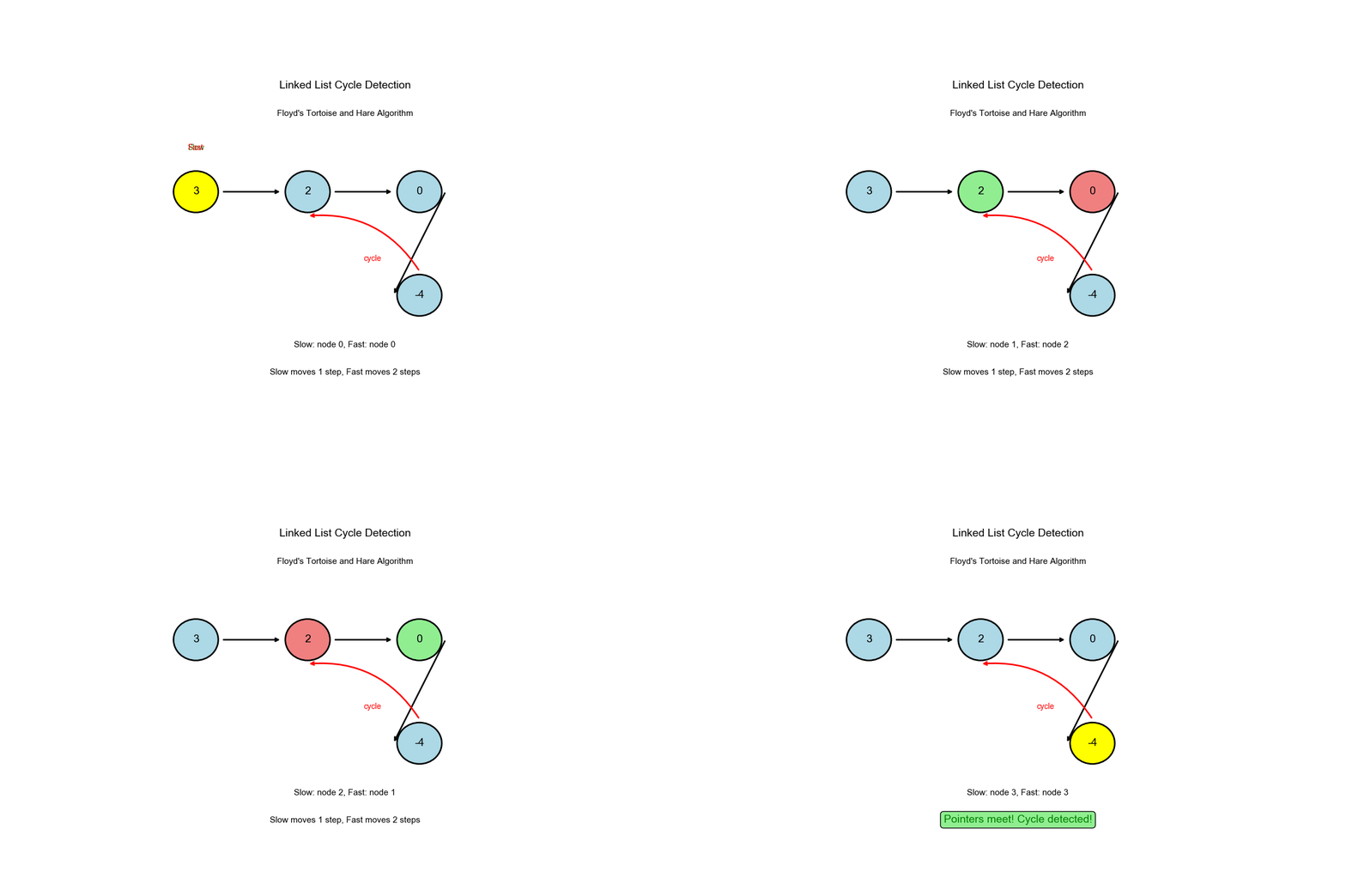
Why Does Fast Pointer Always Catch Slow?
Mathematical proof:
Assume cycle length is
- Each iteration, fast pointer closes gap by 1 step
- Distance changes from
to - After at most
iterations, distance becomes 0 (they meet)
Visualization: Think of clock hands - minute hand (fast) eventually laps hour hand (slow).
Advanced: Find Cycle Entry Point
Problem: Return the node where cycle begins.
Algorithm: 1. Use fast-slow pointers to find meeting point 2. Move one pointer back to head 3. Both pointers move at same speed, they'll meet at cycle entry
1 | def detectCycle(head): |
Why does this work?
Let:
Distance from head to cycle entry:
Distance from cycle entry to meeting point:
Distance from meeting point back to cycle entry:
When they meet: Slow pointer traveled:
Fast pointer traveled:
Since fast is 2x slow: So starting from head and meeting point, moving at same speed, they meet at entry!
LeetCode 202: Happy Number
Problem Statement
Write an algorithm to determine if a number
Example:
- Input:
n = 19 - Output:
true - Explanation: -
- - -
Core Insight
Key observation: If not happy, numbers enter a cycle.
Convert to cycle detection:
- Use fast-slow pointers to detect cycle
- If fast pointer reaches 1, it's happy
- If fast and slow meet (not at 1), it's not happy
Python Implementation
1 | def getNext(n): |
Complexity Analysis
- Time:
- Each operation roughly decreases number size (digit count decreases) - Worst case enters cycle, cycle length is bounded
- Space:
Why Not Use Hash Set?
Hash set approach:
1 | def isHappy_hash(n): |
Comparison:
| Method | Time | Space | Advantage |
|---|---|---|---|
| Hash set | Simpler code | ||
| Fast-slow | Optimal space |
Interview tip: Mention hash set first, then offer fast-slow as space optimization.
Pattern 3: Sliding Window
Core Characteristics
- Maintain a variable-length or fixed-length window
- Left pointer and right pointer define window boundaries
- Dynamically adjust window size to satisfy conditions
Real-World Analogy
Reading a long book to find shortest consecutive chapters containing all key plot points:
- Right pointer: Keep turning pages forward, expanding range
- Left pointer: Once condition met, shrink from beginning
- Eventually find shortest chapter sequence satisfying condition
LeetCode 3: Longest Substring Without Repeating Characters
Problem Statement
Given a string s, find the length of the longest
substring without repeating characters.
Example:
- Input:
s = "abcabcbb" - Output:
3 - Explanation: Longest substring is
"abc"
Constraints:
-s consists of English letters, digits,
symbols and spaces
Core Insight
Sliding window + Hash set: 1. Use hash set to track characters in current window 2. Right pointer expands window, adding new character 3. If duplicate found, left pointer shrinks window until no duplicates 4. Track maximum window length throughout process
Python Implementation
1 | def lengthOfLongestSubstring(s): |
Complexity Analysis
- Time:
- Each character visited at most twice (once by right, once by left) - Space:
- is charset size (e.g., ASCII is 128)
Step-by-Step Example
Input: s = "abcabcbb"
| Step | right |
s[right] |
char_set |
Window | max_length |
Action |
|---|---|---|---|---|---|---|
| 0 | 0 | 'a' |
{'a'} |
"a" |
1 | Add 'a' |
| 1 | 1 | 'b' |
{'a','b'} |
"ab" |
2 | Add 'b' |
| 2 | 2 | 'c' |
{'a','b','c'} |
"abc" |
3 | Add 'c' |
| 3 | 3 | 'a' |
{'b','c'} |
"bca" |
3 | Remove 'a', add 'a' |
| 4 | 4 | 'b' |
{'c','a'} |
"cab" |
3 | Remove 'b', add 'b' |
| 5 | 5 | 'c' |
{'a','b'} |
"abc" |
3 | Remove 'c', add 'c' |
| 6 | 6 | 'b' |
{'a','c'} |
"cb" |
3 | Remove 'b', add 'b' |
| 7 | 7 | 'b' |
{'c'} |
"b" |
3 | Remove 'a', 'b', add 'b' |
Output: 3
Optimization: Hash Map with Index
Further optimization: Instead of removing characters one by one, jump directly to position after duplicate.
1 | def lengthOfLongestSubstring_optimized(s): |
Why max(left, ...)?
Prevents left pointer from moving backward. Example:
s = "abba"
- At
right = 3, encounter second'a' char_index['a'] = 0, naively would setleft = 1- But left might already be at 2 (due to second
'b') - So need
left = max(left, 1)to avoid regression
LeetCode 76: Minimum Window Substring
Problem Statement
Given strings s and t, return the
minimum window substring of s containing
all characters of t. If no such substring exists, return
"".
Example:
- Input:
s = "ADOBECODEBANC",t = "ABC" - Output:
"BANC"
Constraints:
-s and t
consist of English letters - Follow-up:
Core Insight
Sliding window + Frequency counting: 1. Use hash map
to count frequency of each character in t 2. Expand right
boundary, adding characters to window 3. When window contains all
required characters, shrink left boundary to find minimum 4. Track
minimum window's starting position and length
Python Implementation
1 | from collections import Counter, defaultdict |
Complexity Analysis
- Time:
- , - Each character visited at most twice - Space:
- Hash maps store character frequencies
Deep Dive
Algorithm Principle: Why Does This Algorithm Work?
Core Idea: Maintain a window containing all required
characters. Use formed variable to track number of
characters in window that satisfy target frequency. Only when
formed == required does window contain all required
characters.
Why use formed instead of directly comparing
frequency maps: - Directly comparing two frequency maps
requiresformed counter, each update isformed == required,
ensuring window always contains all required characters.
Time Complexity Proof: Why O(m+n)?
- Build target frequency map: Traverse
t, - Main loop: Traverse
s, - Inner while: Although nested, each character visited at most once by left pointer
- Total time:
Key: Left pointer monotonically increases, never moves backward, guaranteeing linear time complexity.
Space Optimization: Is There a More Space-Efficient Method?
Method 1: Use Array Instead of Dictionary (Only for Small
Character Set) For lowercase English letters (26), can use
array: 1
2
3
4target_count = [0] * 26
for c in t:
target_count[ord(c) - ord('a')] += 1
# Space: O(1) instead of O(n)
Method 2: Reuse Variables - Can reuse
char variable, but space savings negligible
Trade-off: For general character sets, using
Counter and defaultdict is reasonable.
Common Mistakes Analysis
| Mistake Type | Wrong Code | Problem | Correct Approach |
|---|---|---|---|
| Wrong formed update | if char in target_count: formed += 1 |
Frequency may exceed target | Check == not >= |
| Use if instead of while | if formed == required: left += 1 |
Only shrink once, may not be minimum | Use while to keep shrinking |
| Forget to record start | Only record length | Cannot return substring | Also record min_left |
Variant Extensions
- Permutation in String: Find shortest substring containing permutation of target string
- Find All Anagrams: Find all starting positions of substrings satisfying condition
- Minimum Window Subsequence: Subsequence instead of substring (more complex)
Key Implementation Details
Detail 1: When to Increment
formed
1 | # ❌ Wrong: Only check existence |
Detail 2: Shrinking Condition
1 | # ❌ Wrong: Shrink only once |
Detail 3: Updating Minimum
1 | # Track both start position and length |
Two Pointers vs Hash Table: When to Choose?
Comparison Table
| Dimension | Two Pointers | Hash Table |
|---|---|---|
| Time Complexity | ||
| Space Complexity | ||
| Applicable Scenarios | Sorted array, linked list, subarray | Unsorted array, frequency counting |
| Code Complexity | More boundary conditions | Relatively simpler |
| Requires Sorting | Usually yes | No |
Selection Guidelines
Prefer Two Pointers When
- Array is sorted or can be sorted
- Need in-place operation (
space) - Problem involves contiguous subarray/substring
- Need to find specific element pairs (not just existence check)
Prefer Hash Table When
- Array is unsorted and can't be sorted (need to preserve indices)
- Need fast lookup for value existence
- Frequency counting problems
- Space is not a limiting factor
Hybrid Approach
Some problems benefit from combining both techniques:
Example: Sliding window (two pointers) + Hash table (frequency counting)
- Minimum Window Substring
- Permutation in String
- Find All Anagrams in a String
Interview Communication Techniques
Template 1: Identifying Two-Pointer Opportunity
"I notice this problem involves sorted array/subarray/pairing, which suggests two pointers. I'll use left-right/fast-slow pointers with [specific movement strategy] to optimize the brute-force
solution."
Template 2: Explaining Movement Logic
"When condition A holds, I move the left pointer to shrink window/decrease value; when condition B holds, I move the right pointer to expand window/increase value. This ensures each element is visited at most constant times, achieving
complexity."
Template 3: Handling Edge Cases
"I need to check several edge cases: empty array, single element, all elements identical. For boundary conditions, I'll ensure pointers don't go out of bounds and correctly handle logic when they meet."
Template 4: Optimization Explanation
"The brute force is
; two pointers optimize to . Though sorting increases complexity to , for large datasets this is still significant improvement. Space complexity is (excluding sorting stack space), better than hash table's ."
Common Mistakes & Debugging Checklist
Mistake 1: Pointer Out of Bounds
1 | # ❌ May go out of bounds |
Mistake 2: Infinite Loop
1 | # ❌ Forgot to move pointers |
Mistake 3: Boundary Condition Handling
1 | # ❌ Inappropriate handling when pointers meet |
Debugging Checklist
✅ Before coding: 1. Determine pattern (collision/fast-slow/sliding window) 2. Clarify initial position of each pointer 3. Define movement and termination conditions 4. Consider edge cases (empty, single element, all same)
✅ After coding: 1. Manually simulate each step with small example 2. Print pointer positions and window contents each iteration 3. Test empty input, single element, boundary values 4. Check handling when pointers meet 5. Verify complexity meets expectation
Practice Problems (10 Recommended)
Collision Pointers
- Two Sum II - Input Array Is Sorted (LeetCode 167) Easy
- Container With Most Water (LeetCode 11) ← Covered Medium
- 3Sum (LeetCode 15) ← Covered Medium
Fast-Slow Pointers
- Linked List Cycle (LeetCode 141) ← Covered Easy
- Linked List Cycle II (LeetCode 142) Medium
- Happy Number (LeetCode 202) ← Covered Easy
Sliding Window
- Longest Substring Without Repeating Characters (LeetCode 3) ← Covered Medium
- Minimum Window Substring (LeetCode 76) ← Covered Hard
- Minimum Size Subarray Sum (LeetCode 209) Medium
- Permutation in String (LeetCode 567) Medium
Summary: Two Pointers Essence in One Page
Three Pattern Quick Reference
| Pattern | Mnemonic | Typical Problems |
|---|---|---|
| Collision Pointers | Squeeze from ends, adjust sum/diff | Container With Water, 3Sum |
| Fast-Slow Pointers | Speed differential, detect cycles | List Cycle, Happy Number |
| Sliding Window | Expand right shrink left, dynamic interval | Longest Substring, Min Window |
When to Use?
Consider two pointers when seeing these keywords:
- "Sorted array"
- "Contiguous subarray/substring"
- "Pairing/triplets"
- "Linked list cycle/middle"
- "
space"
Common Pitfalls
- Pointer out of bounds: Always check
right + 1 < len - Infinite loop: Every branch must move pointer
- Boundary confusion:
<vs<=, depends on problem - Duplicate elements: Skip duplicates after sorting
Interview Golden Phrase
"This problem's brute force is
, but I notice [sorted/subarray/pairing] characteristics, which suggests [collision/fast-slow/sliding window] two pointers can optimize to , with space complexity. This is the optimal balance of time and space."
Memory Cheat
Collision squeezes adjust sum/diff, fast-slow catches finds cycles, sliding window expands shrinks seeks intervals, two pointers clever saves space!
What's Next?
In LeetCode (3) Linked List Operations, we'll dive into:
- Reverse Linked List: Iterative vs Recursive
- Merge Lists: Applying merge sort thinking
- List Sorting:
time space - Fast-Slow Advanced: Find middle, k-th from end
Thought question: How to perform merge sort on
linked list in
Further Reading
- Books:
- "Cracking the Coding Interview" (Chapter 2: Linked Lists & Two Pointers)
- "Introduction to Algorithms" (Chapter 10: Basic Data Structures)
- Papers:
- Floyd's Cycle Detection Algorithm (1967)
- Visualization:
- VisuAlgo - Linked Lists & Two Pointers: https://visualgo.net/en/list
- LeetCode: Two Pointers tag (150+ problems)
Two pointers isn't a fancy trick — it's deep understanding of data structure properties. Master it, and you'll solve many seemingly complex problems in linear time!
❓ Q&A: Two Pointers Interview Tips
Q1: Fast/Slow Pointer vs Opposite-End Pointers - When to Use Each?
Answer: The choice depends on the problem structure and what you're trying to achieve.
Fast-Slow Pointers (different speeds):
- Use when: Working with linked lists, cycle detection, finding middle elements, or problems where you need to track relative positions
- Key insight: The speed differential creates a "chasing" effect that naturally detects cycles or finds specific positions
- Example: Linked List Cycle - fast pointer moves 2 steps, slow moves 1 step. If there's a cycle, fast will eventually catch slow.
1 | # Fast-slow pattern |
Opposite-End Pointers (collision pointers):
- Use when: Working with sorted arrays, finding pairs/triplets, or problems where you can make decisions based on both ends
- Key insight: Starting from both ends allows you to eliminate half the search space with each comparison
- Example: Two Sum II - if sum too small, move left pointer right; if too large, move right pointer left.
1 | # Collision pattern |
Decision Tree:
- Linked list problem → Fast-slow pointers
- Sorted array + pairs/triplets → Collision pointers
- Need to find middle → Fast-slow pointers
- Need to optimize sum/difference → Collision pointers
Complexity: Both achieve
Q2: Sliding Window vs Two Pointers - What's the Difference?
Answer: Sliding window is actually a specialized form of two pointers optimized for contiguous subarray/substring problems.
Two Pointers (General):
- Pointers can move independently or converge
- Used for: pairing, cycle detection, finding specific positions
- Movement: Often moves based on comparison (e.g., sum too small/large)
Sliding Window:
- Maintains a contiguous interval between pointers
- Used for: subarray/substring problems with constraints
- Movement: Right pointer expands window, left pointer shrinks when condition met
- Key characteristic: Window size can be fixed or variable
Visual Comparison:
1 | Two Pointers (Collision): |
When to Use Sliding Window:
- Keywords: "subarray", "substring", "contiguous", "window"
- Need to track elements within a range
- Problem asks for minimum/maximum length satisfying condition
Example: Longest Substring Without Repeating Characters
- Sliding window: Maintain window of unique characters
- Not collision pointers: We're not converging from ends
- Not fast-slow: Both pointers move forward, just at different rates
Complexity: Sliding window typically achieves
Q3: How to Avoid Infinite Loops in Two-Pointer Algorithms?
Answer: Ensure every code path moves at least one pointer and termination condition is always reachable.
Common Causes:
Forgotten pointer movement:
1
2
3
4
5
6
7
8
9
10
11
12
13
14
15
16# ❌ BAD: Infinite loop risk
while left < right:
if nums[left] + nums[right] == target:
# Found solution, but forgot to move pointers!
pass
# ✅ GOOD: Always move pointers
while left < right:
if nums[left] + nums[right] == target:
result.append([left, right])
left += 1 # Must move!
right -= 1 # Must move!
elif nums[left] + nums[right] < target:
left += 1
else:
right -= 1Termination condition never met:
1
2
3
4
5
6
7
8# ❌ BAD: Condition might never be false
while True:
if some_condition:
break # But what if condition never becomes true?
# ✅ GOOD: Explicit termination
while left < right: # Natural termination when pointers meet
# ... logic that guarantees left or right movesPointer movement in wrong direction:
1
2
3
4
5
6
7
8
9
10
11
12
13# ❌ BAD: Pointers moving toward each other but logic prevents meeting
while left < right:
if condition:
left += 1
else:
left += 1 # Both branches move same pointer!
# ✅ GOOD: At least one pointer always moves toward the other
while left < right:
if condition:
left += 1 # Moves toward right
else:
right -= 1 # Moves toward left
Debugging Checklist:
- ✅ Every
if/elif/elsebranch moves at least one pointer - ✅ Termination condition (
left < rightorleft <= right) will eventually be false - ✅ Pointer movements are in correct direction (converging, not diverging)
- ✅ No early returns that skip pointer updates
Test Cases to Catch Infinite Loops:
- Empty array:
[] - Single element:
[1] - All elements identical:
[2, 2, 2, 2] - Edge case where pointers meet immediately
Q4: What Are Common Edge Cases in Two-Pointer Problems?
Answer: Edge cases often involve boundary conditions and special input patterns. Always test these systematically.
Critical Edge Cases:
Empty Array:
1
2
3
4
5def twoSum(nums, target):
if not nums: # ✅ Check first!
return []
left, right = 0, len(nums) - 1
# ... rest of logicSingle Element:
1
2
3
4
5# For collision pointers: left == right immediately
# For fast-slow: fast.next might be None immediately
def hasCycle(head):
if not head or not head.next: # ✅ Single node can't have cycle
return FalseAll Elements Identical:
1
2
3
4
5
6
7
8
9
10
11
12# Example: nums = [2, 2, 2, 2], target = 4
# Need to handle duplicates correctly
while left < right:
if nums[left] + nums[right] == target:
result.append([left, right])
# ✅ Skip duplicates
while left < right and nums[left] == nums[left+1]:
left += 1
while left < right and nums[right] == nums[right-1]:
right -= 1
left += 1
right -= 1Pointers Meet at Boundary:
1
2
3
4# What if solution is at indices [0, 1] or [n-2, n-1]?
# Ensure loop handles first and last elements
while left < right: # ✅ Allows left=0, right=1
# ... logicNo Valid Solution:
1
2
3
4
5
6
7# Example: Sorted array, but no pair sums to target
# Should return empty result, not crash
def twoSum(nums, target):
left, right = 0, len(nums) - 1
while left < right:
# ... logic
return [] # ✅ No solution foundArray with Duplicates (3Sum/4Sum):
1
2
3
4
5
6
7
8
9
10# Must skip duplicates at THREE levels:
# 1. First number
if i > 0 and nums[i] == nums[i-1]:
    continue
# 2. Second number (left pointer)
while left < right and nums[left] == nums[left+1]:
left += 1
# 3. Third number (right pointer)
while left < right and nums[right] == nums[right-1]:
right -= 1
Edge Case Testing Template: 1
2
3
4
5
6
7
8
9test_cases = [
[], # Empty
[1], # Single element
[1, 1], # Two identical
[1, 1, 1, 1], # All identical
[1, 2, 3, 4, 5], # Normal case
[1, 2], # Minimum size
[1] * 10000, # Large input, all same
]
Interview Tip: Always mention edge cases before coding: "I'll need to handle empty array, single element, and duplicate elements. Let me code the main logic first, then add these checks."
Q5: Two Pointers in Linked Lists vs Arrays - Key Differences?
Answer: The fundamental difference is random access vs sequential access, which affects how pointers move and what operations are possible.
Arrays (Random Access):
- Can jump to any index:
nums[i],nums[j] - Pointers are indices:
left = 0,right = len(nums) - 1 - Can move backward:
right -= 1 - Can calculate distance:
right - left - Typical patterns: Collision pointers, sliding window
1 | # Array: Easy to move in both directions |
Linked Lists (Sequential Access):
- Must traverse from head:
node = node.next - Pointers are node references:
slow = head,fast = head - Can only move forward:
node = node.next(nonode.previn singly-linked list) - Cannot calculate distance easily (need to traverse)
- Typical patterns: Fast-slow pointers, cycle detection
1 | # Linked list: Can only move forward |
Key Differences Table:
| Aspect | Arrays | Linked Lists |
|---|---|---|
| Access Pattern | Random (O(1)) | Sequential (O(n)) |
| Pointer Type | Integer indices | Node references |
| Movement | Bidirectional | Forward only (singly-linked) |
| Distance Calculation | right - left |
Must traverse |
| Common Pattern | Collision pointers | Fast-slow pointers |
| Boundary Check | left < len(nums) |
node is not None |
When Arrays Are Better:
- Need to compare elements at both ends
- Problem requires sorting (arrays easier to sort)
- Need to calculate distances or indices
When Linked Lists Are Better:
- Problem involves cycles (fast-slow naturally detects)
- Need to find middle without knowing length
- Dynamic size (insertions/deletions)
Hybrid Approach Example: Some problems convert
linked list to array first: 1
2
3
4
5
6
7
8
9
10
11
12
13
14# Convert to array, then use collision pointers
def isPalindrome(head):
values = []
while head:
values.append(head.val)
head = head.next
# Now use array two pointers
left, right = 0, len(values) - 1
while left < right:
if values[left] != values[right]:
return False
left += 1
right -= 1
return True
Complexity Trade-off: Converting to array uses
Q6: What Is the Three Pointers Technique?
Answer: Three pointers extend two-pointer logic to handle three-way partitioning or problems requiring three simultaneous references.
Common Use Cases:
- Dutch National Flag Problem (3-way partition):
1
2
3
4
5
6
7
8
9
10
11
12
13
14
15
16
17
18
19
20# Sort array with three colors: 0 (red), 1 (white), 2 (blue)
def sortColors(nums):
# Three pointers:
# left: boundary of 0s (everything before left is 0)
# right: boundary of 2s (everything after right is 2)
# curr: current element being processed
left = curr = 0
right = len(nums) - 1
while curr <= right:
if nums[curr] == 0:
nums[left], nums[curr] = nums[curr], nums[left]
left += 1
curr += 1
elif nums[curr] == 2:
nums[curr], nums[right] = nums[right], nums[curr]
right -= 1
# Don't increment curr! Need to check swapped element
else: # nums[curr] == 1
curr += 1
Visualization: 1
2
3
4
5
6
7
8Initial: [2, 0, 2, 1, 1, 0]
↑ ↑ ↑
left curr right
After: [0, 0, 1, 1, 2, 2]
↑ ↑
left right
(curr finished)
Partition Array (pivot-based):
1
2
3
4
5
6
7
8
9
10
11
12
13
14
15# Partition so elements < pivot on left, = pivot in middle, > pivot on right
def partition(nums, pivot):
left = curr = 0
right = len(nums) - 1
while curr <= right:
if nums[curr] < pivot:
nums[left], nums[curr] = nums[curr], nums[left]
left += 1
curr += 1
elif nums[curr] > pivot:
nums[curr], nums[right] = nums[right], nums[curr]
right -= 1
else:
curr += 14Sum Problem (nested two pointers):
1
2
3
4
5
6
7
8
9
10
11
12
13
14
15
16
17
18
19
20# Fix two numbers, then use two pointers for remaining two
def fourSum(nums, target):
nums.sort()
result = []
n = len(nums)
for i in range(n - 3): # First pointer
for j in range(i + 1, n - 2): # Second pointer
left = j + 1 # Third pointer
right = n - 1 # Fourth pointer
while left < right:
total = nums[i] + nums[j] + nums[left] + nums[right]
if total == target:
result.append([nums[i], nums[j], nums[left], nums[right]])
# Skip duplicates...
elif total < target:
left += 1
else:
right -= 1
Key Insight: Three pointers often maintain three regions:
- Region 1: Elements processed and placed correctly (before
left) - Region 2: Elements being processed (
lefttocurr) - Region 3: Elements processed and placed correctly (after
right)
Complexity: Still
When to Use:
- Problem requires three-way partitioning
- Need to track three boundaries simultaneously
- Extending two-pointer logic to handle three elements (like 3Sum → 4Sum)
Q7: Two Pointers with Sorting - What Are the Trade-offs?
Answer: Sorting enables two-pointer techniques but
adds
Trade-off Analysis:
Without Sorting (Hash Table Approach):
1
2
3
4
5
6
7
8# Two Sum - unsorted array
def twoSum(nums, target):
seen = {}
for i, num in enumerate(nums):
complement = target - num
if complement in seen:
return [seen[complement], i]
seen[num] = i
With Sorting (Two Pointers): 1
2
3
4
5
6
7
8
9
10
11
12# Two Sum II - sorted array
def twoSum(nums, target):
nums.sort() # O(n log n)
left, right = 0, len(nums) - 1
while left < right:
current_sum = nums[left] + nums[right]
if current_sum == target:
return [left, right] # But these are NEW indices after sort!
elif current_sum < target:
left += 1
else:
right -= 1
When Sorting Is Worth It:
✅ Use sorting + two pointers when:
- Problem asks for values, not indices (like 3Sum, 4Sum)
- Space is constrained (
vs matters) - Problem requires multiple queries (sort once, query many times)
- Need to find all pairs/triplets (hash table gets complex)
❌ Avoid sorting when:
- Problem requires original indices (Two Sum original)
- Array is already sorted (use two pointers directly!)
- Single query and space isn't concern (hash table simpler)
Hybrid Approach (Best of Both Worlds):
1
2
3
4
5
6
7
8
9
10
11
12
13
14# Store original indices before sorting
def twoSumWithIndices(nums, target):
indexed = [(nums[i], i) for i in range(len(nums))]
indexed.sort(key=lambda x: x[0]) # Sort by value
left, right = 0, len(indexed) - 1
while left < right:
current_sum = indexed[left][0] + indexed[right][0]
if current_sum == target:
return [indexed[left][1], indexed[right][1]] # Original indices!
elif current_sum < target:
left += 1
else:
right -= 1
Complexity Comparison:
| Approach | Time | Space | Preserves Indices |
|---|---|---|---|
| Hash Table | ✅ Yes | ||
| Sort + Two Pointers | ❌ No | ||
| Sort + Store Indices | ✅ Yes |
Interview Communication: > "I can solve this with
a hash table in
Q8: How to Optimize Space Complexity with Two Pointers?
Answer: Two pointers naturally achieve
Space Optimization Techniques:
Replace Hash Table with Two Pointers:
1
2
3
4
5
6
7
8
9
10
11
12
13
14
15
16# ❌ Hash table: O(n) space
def hasDuplicate(nums):
seen = set() # O(n) space
for num in nums:
if num in seen:
return True
seen.add(num)
return False
# ✅ Two pointers (if sorted): O(1) space
def hasDuplicate(nums):
nums.sort() # In-place, O(log n) stack space
for i in range(len(nums) - 1):
if nums[i] == nums[i+1]: # Adjacent comparison
return True
return FalseIn-Place Array Modification:
1
2
3
4
5
6
7
8
9
10
11
12# Remove duplicates in-place
def removeDuplicates(nums):
if not nums:
return 0
# Two pointers: write pointer and read pointer
write = 0 # Position to write next unique element
for read in range(1, len(nums)):
if nums[read] != nums[write]:
write += 1
nums[write] = nums[read] # In-place modification
return write + 1
- Space:
(only two integer pointers) - Alternative: Create new array →
space
Avoid Recursion Stack:
1
2
3
4
5
6
7
8
9
10
11
12
13
14
15
16
17
18
19# ❌ Recursive: O(n) stack space
def reverseList(head):
if not head or not head.next:
return head
new_head = reverseList(head.next) # Recursion stack
head.next.next = head
head.next = None
return new_head
# ✅ Iterative two pointers: O(1) space
def reverseList(head):
prev = None
curr = head
while curr:
next_temp = curr.next
curr.next = prev
prev = curr
curr = next_temp
return prevSliding Window Without Hash Table (when possible):
1
2
3
4
5
6
7
8
9
10
11
12
13
14
15
16
17
18
19# For problems with limited character set, use array instead of hash map
def lengthOfLongestSubstring(s):
# ASCII has 128 characters, so array[128] is O(1) space
# vs hash map which is O(min(n, 128)) but with overhead
char_count = [0] * 128 # Fixed size, O(1) space
left = 0
max_len = 0
for right in range(len(s)):
char_count[ord(s[right])] += 1
# Shrink window if duplicate
while char_count[ord(s[right])] > 1:
char_count[ord(s[left])] -= 1
left += 1
max_len = max(max_len, right - left + 1)
return max_len
Space Complexity Breakdown:
| Technique | Space Complexity | Notes |
|---|---|---|
| Two pointers (basic) | Only pointer variables | |
| Two pointers + sorting | Recursive sort stack space | |
| Two pointers + hash table | Defeats space optimization | |
| Sliding window + array | ||
| Sliding window + hash map |
When
- Memory-constrained environments (embedded systems)
- Large datasets where
extra space is prohibitive - Interview optimization (shows understanding of trade-offs)
- In-place algorithms required by problem statement
Trade-off Awareness: Sometimes
- Sorting requirement: Adds
time preprocessing - Code complexity: Two pointers can be trickier than hash table
- Index preservation: May lose original positions
Interview Tip: Always mention both approaches: >
"I can solve this with a hash table in
Q9: Interview Communication Tips for Two-Pointer Problems
Answer: Effective communication demonstrates problem-solving process and trade-off awareness. Structure your explanation clearly.
Template 1: Problem Recognition: > "I notice this
problem involves [sorted array / subarray / cycle detection], which
suggests two pointers could optimize the brute-force
Template 2: Pattern Selection: > "Given that [array is sorted / we need contiguous subarray / we're working with linked list], I'll use [collision pointers / sliding window / fast-slow pointers] because [specific reason]."
Template 3: Algorithm Explanation: > "I'll maintain two pointers: [left/right or slow/fast]. The [left/slow] pointer will [specific movement], and the [right/fast] pointer will [specific movement]. When [condition], I'll [action], which ensures [invariant/maintains correctness]."
Template 4: Complexity Analysis: > "Time
complexity is
Template 5: Edge Cases: > "Before coding, I should handle: [1] empty input, [2] single element, [3] all elements identical, [4] no valid solution. Let me code the main logic first, then add these checks."
Template 6: Optimization Discussion: > "The brute
force would be
Common Phrases to Use:
- "I'll use a greedy approach where..."
- "This maintains the invariant that..."
- "Each iteration eliminates [portion] of remaining possibilities..."
- "The key insight is that we can [decision] based on [comparison]..."
What Interviewers Want to Hear:
✅ Good Communication:
- Explains why you chose two pointers
- Mentions alternatives (hash table, brute force)
- Discusses trade-offs (time vs space)
- Identifies edge cases proactively
- Walks through example step-by-step
❌ Poor Communication:
- Jumps straight to code without explanation
- Doesn't mention alternatives
- Ignores edge cases until asked
- Can't explain why algorithm is correct
- Doesn't analyze complexity
Example Full Explanation: > "This is a classic
two-pointer problem. The brute force would check all pairs in
Body Language Tips:
- Think out loud: Don't code silently
- Draw diagrams: Visualize pointer movements
- Ask clarifying questions: "Should I handle duplicates?" "Do you want indices or values?"
- Test with example: Walk through small input manually
Red Flags to Avoid:
- ❌ "I'll just use two pointers" (too vague)
- ❌ Coding without explaining (interviewer can't follow)
- ❌ Ignoring follow-up questions
- ❌ Not testing edge cases
Q10: How to Debug Two-Pointer Algorithms?
Answer: Systematic debugging involves manual tracing, print statements, and systematic test cases. Most bugs come from boundary conditions or pointer movement logic.
Debugging Strategy:
Manual Step-by-Step Tracing:
1
2
3
4
5
6
7
8
9
10
11
12
13# Example: Two Sum
nums = [2, 7, 11, 15], target = 9
# Trace each iteration:
# Iteration 1: left=0, right=3
# nums[0] + nums[3] = 2 + 15 = 17 > 9
# → Move right: right = 2
# Iteration 2: left=0, right=2
# nums[0] + nums[2] = 2 + 11 = 13 > 9
# → Move right: right = 1
# Iteration 3: left=0, right=1
# nums[0] + nums[1] = 2 + 7 = 9 == target
# → Return [0, 1] ✓Add Print Statements:
1
2
3
4
5
6
7
8
9
10
11
12
13
14
def twoSum(nums, target):
left, right = 0, len(nums) - 1
while left < right:
current_sum = nums[left] + nums[right]
print(f"left={left}, right={right}, sum={current_sum}") # Debug
if current_sum == target:
return [left, right]
elif current_sum < target:
left += 1
print(f"Moving left to {left}") # Debug
else:
right -= 1
print(f"Moving right to {right}") # DebugCheck Invariants:
1
2
3
4
5
6
7
8
9
10
11
12
13
14
15
16
17
18
19# What should always be true?
def maxArea(height):
left, right = 0, len(height) - 1
max_area = 0
while left < right:
# Invariant: left < right (check this!)
assert left < right, f"Invariant violated: left={left}, right={right}"
width = right - left
current_area = min(height[left], height[right]) * width
max_area = max(max_area, current_area)
if height[left] < height[right]:
left += 1
else:
right -= 1
return max_areaTest Edge Cases Systematically:
1
2
3
4
5
6
7
8
9
10
11
12
13
14def test_twoSum():
test_cases = [
([], 5, []), # Empty
([1], 1, []), # Single element
([1, 2], 3, [0, 1]), # Two elements
([1, 1, 1], 2, [0, 1]), # All same
([1, 2, 3, 4], 10, []), # No solution
([1, 2, 3, 4], 7, [2, 3]), # Normal case
]
for nums, target, expected in test_cases:
result = twoSum(nums, target)
assert result == expected, f"Failed: {nums}, target={target}"
print(f"✓ Passed: {nums}")
Common Bugs and Fixes:
Bug 1: Off-by-One Error: 1
2
3
4
5
6
7
8
9# ❌ BAD: Might skip last element
for i in range(len(nums) - 1):
if nums[i] + nums[i+1] == target:
return [i, i+1]
# ✅ GOOD: Check boundary
for i in range(len(nums)):
if i + 1 < len(nums) and nums[i] + nums[i+1] == target:
return [i, i+1]
Bug 2: Pointer Not Moving: 1
2
3
4
5
6
7
8
9
10
11
12
13
14# ❌ BAD: Infinite loop
while left < right:
if nums[left] + nums[right] == target:
# Forgot to move pointers!
pass
# ✅ GOOD: Always move
while left < right:
if nums[left] + nums[right] == target:
return [left, right]
elif nums[left] + nums[right] < target:
left += 1
else:
right -= 1
Bug 3: Wrong Comparison: 1
2
3
4
5
6
7# ❌ BAD: Moving wrong pointer
if nums[left] + nums[right] < target:
right -= 1 # Wrong! Should move left
# ✅ GOOD: Move pointer that increases sum
if nums[left] + nums[right] < target:
left += 1 # Increase sum
Debugging Checklist:
Interview Debugging Tips: 1. Don't panic: Bugs are normal, show debugging process 2. Explain your thinking: "I think the issue might be..." 3. Test incrementally: Add one test case at a time 4. Use examples: Walk through concrete input 5. Check assumptions: "I assumed the array was sorted, is that correct?"
🎓 Summary: Two Pointers Cheat Sheet
Quick Pattern Recognition
| Problem Type | Pattern | Initialization | Movement Strategy |
|---|---|---|---|
| Sorted array pairs | Collision | left=0, right=n-1 |
Sum too small → left++, too large →
right-- |
| Linked list cycle | Fast-slow | slow=fast=head |
slow=slow.next, fast=fast.next.next |
| Subarray/substring | Sliding window | left=0, right=0 |
Expand right, shrink left when condition
met |
| Three-way partition | Three pointers | left=curr=0, right=n-1 |
Move curr, swap with left or
right |
Complexity Cheat Sheet
| Pattern | Time | Space | When Optimal |
|---|---|---|---|
| Collision pointers | Sorted array, pairing problems | ||
| Fast-slow pointers | Cycle detection, finding middle | ||
| Sliding window | Contiguous subarray problems | ||
| Sort + two pointers | When space optimization needed |
Common Templates
Template 1: Collision Pointers 1
2
3
4
5
6
7
8
9
10
11left, right = 0, len(nums) - 1
while left < right:
# Process current pair
if condition:
# Found solution or update result
left += 1
right -= 1
elif condition:
left += 1
else:
right -= 1
Template 2: Fast-Slow Pointers 1
2
3
4
5
6
7slow = fast = head
while fast and fast.next:
slow = slow.next
fast = fast.next.next
if slow == fast:
# Cycle detected or found position
break
Template 3: Sliding Window 1
2
3
4
5
6
7left = 0
for right in range(len(nums)):
# Expand window: add nums[right]
while condition_not_met:
# Shrink window: remove nums[left]
left += 1
# Update result
Edge Cases Checklist
Debugging Quick Reference
- Print pointers:
print(f"left={left}, right={right}") - Check bounds:
if left < len(nums) and right >= 0 - Verify movement: Every branch moves at least one pointer
- Test termination: Will
left < righteventually be false? - Manual trace: Walk through small example step-by-step
Interview Phrases
- "I notice [characteristic], which suggests two pointers..."
- "The brute force is
, but two pointers optimize to ..." - "I'll use [pattern] because [reason]..."
- "Edge cases to consider: [list]..."
- "Time is
since each element visited once, space is ..."
Memory Mnemonics
- Collision: "Squeeze from ends, adjust sum/diff"
- Fast-slow: "Speed differential, detect cycles"
- Sliding window: "Expand right, shrink left, dynamic interval"
Final Thought: Two pointers isn't about memorizing templates — it's about recognizing when eliminating half the search space or maintaining invariants can optimize your solution. Master the three core patterns, handle edge cases systematically, and communicate your reasoning clearly. With practice, you'll spot two-pointer opportunities instinctively!
- Post title:LeetCode (2): Two Pointers - Collision, Fast-Slow & Sliding Window Complete Guide
- Post author:Chen Kai
- Create time:2023-04-18 00:00:00
- Post link:https://www.chenk.top/en/leetcode-two-pointers/
- Copyright Notice:All articles in this blog are licensed under BY-NC-SA unless stating additionally.