If you ask a machine learning engineer "what math do you use most
often?", the answer is almost certainly linear algebra.
From vector representations of data, to forward propagation in neural
networks, to matrix factorization in recommender systems — linear
algebra is the "native language" of machine learning. This chapter
starts from intuition and dives deep into the linear algebra principles
behind these core algorithms.
Vector
Representations in Machine Learning
Data as Vectors
The first step in machine learning is converting real-world objects
into vectors. A pixel
handwritten digit image can be flattened into a 784-dimensional vector;
a piece of text can be converted to a vector using word frequency
statistics or word embeddings; a user's behavior history can be encoded
as a feature vector.
Why do this? Because vectors are the fundamental objects of
linear algebra operations. Once data becomes vectors, we
can:
Suppose we have samples, each
with features. We organize the
data into a matrix:
where
is the feature vector of sample .
Geometrically, each sample is a point in -dimensional space.
This perspective is crucial: many machine learning tasks are
essentially geometric operations in high-dimensional space:
Classification: Find a hyperplane separating points
of different classes
Clustering: Find natural groupings of points
Dimensionality reduction: Project high-dimensional
points to a lower-dimensional subspace
Regression: Find a hyperplane as close as possible
to all points
Word Embeddings:
Vectorizing Semantics
Word2Vec, GloVe, and other embedding methods map words to
low-dimensional vector spaces, placing semantically similar words closer
together. More remarkably, these vectors can perform "semantic
arithmetic":
This shows word embeddings capture some linear structure: the gender
difference is encoded as a direction vector .
1
2
3
4
5
6
7
8
9
10
11
12
13
import numpy as np from gensim.models import KeyedVectors
# Load pre-trained word vectors model = KeyedVectors.load_word2vec_format('GoogleNews-vectors-negative300.bin', binary=True)
# Compute cosine similarity between word vectors similarity = model.similarity('cat', 'dog') print(f"Similarity between cat and dog: {similarity:.4f}")
Principal Component Analysis
(PCA)
Starting
from Intuition: Finding the "Principal Axes" of Data
Imagine paper clips scattered on a table. Looking down from above,
you notice they roughly align along a certain direction (because paper
clips are elongated). PCA's job is to find this "principal
direction."
More formally: PCA seeks the direction of maximum data
variance. Why focus on variance? Because directions with large
variance contain more information, while directions with small variance
may just be noise.
Mathematical Derivation
Assume data is centered (zero mean). We want to find a unit vector
that maximizes variance
when data is projected onto it:
Denoting the covariance matrix , the problem becomes:
Using Lagrange multipliers:
We get . This is an eigenvalue problem! The optimal
is the eigenvector
corresponding to the largest eigenvalue of the covariance
matrix.
Relationship Between PCA and
SVD
In practice, PCA is usually computed not by directly forming the
covariance matrix (which can be huge when features are many), but by
using SVD. For centered data matrix :
Here, columns of are the
principal component directions (eigenvectors of the covariance matrix),
and diagonal elements of
squared divided by give the
corresponding variances (eigenvalues).
# Original data with principal component directions axes[0].scatter(X[:, 0], X[:, 1], alpha=0.5) for i, (comp, var) inenumerate(zip(pca.components_, pca.explained_variance_)): axes[0].arrow(0, 0, comp[0]*np.sqrt(var)*2, comp[1]*np.sqrt(var)*2, head_width=0.2, head_length=0.1, fc=['r', 'b'][i], ec=['r', 'b'][i]) axes[0].set_title('Original Data with Principal Directions') axes[0].set_xlabel('x1') axes[0].set_ylabel('x2') axes[0].axis('equal')
# Transformed data axes[1].scatter(X_pca[:, 0], X_pca[:, 1], alpha=0.5) axes[1].set_title('Data After PCA') axes[1].set_xlabel('PC1') axes[1].set_ylabel('PC2') axes[1].axis('equal')
Data visualization: Project high-dimensional data to
2D or 3D for human inspection. For example, project 784-dimensional
MNIST images to 2D to see how different digits distribute.
Dimensionality reduction and compression: Keep the
firstprincipal components, discard
the rest, achieving data compression. If the first 10 components explain
95% of variance, using 10 dimensions instead of 1000 loses little
information.
Denoising: Assume signal lies in major components
and noise in minor components. Keeping major components filters out
noise.
Feature decorrelation: After PCA, new features are
orthogonal (uncorrelated), which helps certain algorithms (like Naive
Bayes).
Kernel PCA: Handling
Nonlinear Structure
Standard PCA only finds linear structure. If data lies on a curved
manifold (like a "Swiss roll"), PCA is helpless.
Kernel PCA's idea: First map data to a high-dimensional feature space
,
then do PCA in feature space. But we don't need to explicitly compute
, only the inner
product , which can
be computed directly using a kernel function .
PCA is unsupervised — it doesn't know class labels. LDA is
supervised: it uses class information to find projection directions that
best separate different classes.
Intuitively, LDA seeks a direction where: 1. Class centers are as far
apart as possible after projection (large between-class distance) 2.
Points within each class are as close together as possible after
projection (small within-class variance)
Mathematical Formulation
Let there beclasses, with
classhavingsamples, mean, and overall mean.
Within-class scatter matrix (measuring dispersion
within each class):
Between-class scatter matrix (measuring dispersion
between class centers):
LDA maximizes the generalized Rayleigh quotient:
This is equivalent to solving the generalized eigenvalue problem
.
Fisher
Discriminant for Binary Classification
For two-class problems, Fisher gave a more direct derivation.
Projected between-class distance is ,
within-class variance is . Fisher's criterion:
from sklearn.discriminant_analysis import LinearDiscriminantAnalysis from sklearn.datasets import load_iris import numpy as np import matplotlib.pyplot as plt
An important limitation: LDA can reduce to at mostdimensions (is number of classes). For binary
classification, LDA can only reduce to 1D.
Support Vector
Machines and Kernel Methods
Linear SVM: Maximum Margin
Classifier
Support vector machines seek a hyperplaneseparating two
classes with maximum margin.
What is margin? Intuitively, it's the distance from the hyperplane to
the nearest data points. The distance from pointto the hyperplane is.
For correctly classified points,.
By appropriately scalingand, we can make the nearest points
satisfy. Then the margin is.
Optimization Problem
Primal problem:
Using Lagrange multipliers, introduce :
Dual problem (after optimizing over and ):
Notice the dual only involves inner products between data points.
This is key to the kernel trick!
The Kernel Trick
If data is linearly inseparable, one approach is mapping data to a
higher-dimensional space. For example, for 2D data, map to:A circular boundary in the original
space may become linear in the new space.
The problem is: high-dimensional mappings are computationally
expensive. The beauty of the kernel trick is that we
only need to compute inner products, which can
be done directly with a simple function, without explicitly
computing.
Common kernel functions:
Linear kernel:
Polynomial kernel:
RBF kernel (Gaussian):
Sigmoid kernel:
The RBF kernel corresponds to an infinite-dimensional feature space!
But computing inner products only takes time.
Kernel Matrix and
Positive Definiteness
Given data points, the
kernel matrix (Gram matrix) is defined as:
A function is a valid kernel if and only if for any dataset, the
kernel matrix is positive semi-definite (all eigenvalues ). This is called the
Mercer condition.
Intuitively, theelement of
the kernel matrix measures "similarity" between samplesand. Positive semi-definiteness ensures
this similarity measure is self-consistent.
print(f"Linear SVM accuracy: {svm_linear.score(X, y):.2f}") print(f"RBF kernel SVM accuracy: {svm_rbf.score(X, y):.2f}") print(f"Number of support vectors: {len(svm_rbf.support_vectors_)}")
Matrix
Factorization and Recommender Systems
The Netflix Problem
A classic recommender system problem: There is a user-movie rating
matrix(users,movies), but most elements are missing
(users can't have watched all movies). The goal is to predict
missing ratings and recommend movies users might like.
Low-Rank Assumption
Core assumption: User preferences and movie characteristics can be
described by a small number of "latent factors." For example, factors
might correspond to "action level," "romance level," "star presence,"
etc.
Sometimes we want decomposition results to be non-negative for
interpretability. For example, in document-word matrix factorization,
non-negative factors can be interpreted as "topics."NMF tends to produce sparse, parts-based representations,
unlike SVD's global representations that may have positive and negative
values.
# Show top words for each topic feature_names = vectorizer.get_feature_names_out() for topic_idx, topic inenumerate(H): top_words = [feature_names[i] for i in topic.argsort()[:-10:-1]] print(f"Topic {topic_idx}: {', '.join(top_words)}")
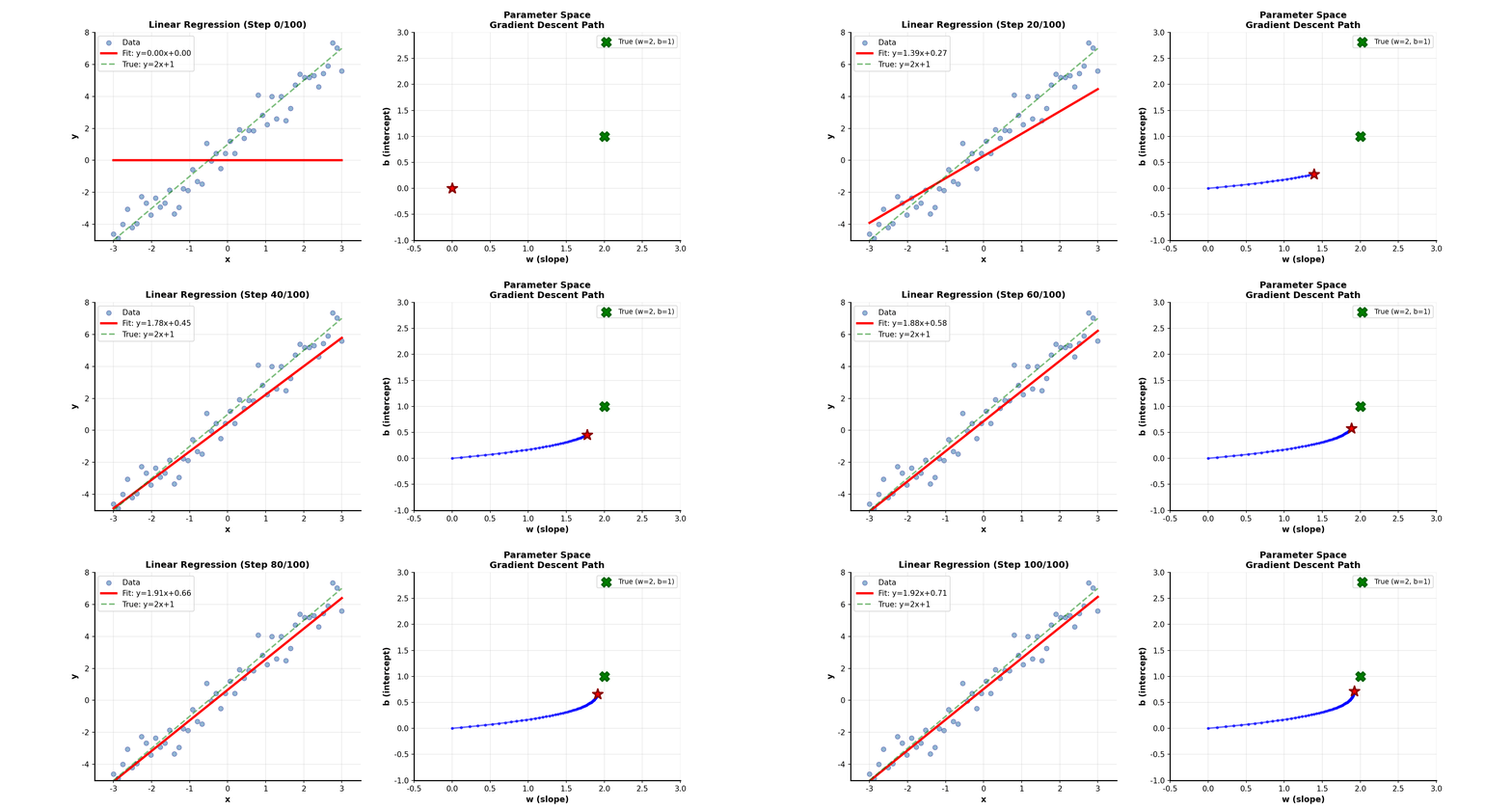
Matrix Form of Linear
Regression
From Scalars to Matrices
The familiar simple linear regression generalizes to multiple variables as:
Stacking all samples, in
matrix form:
where is the design matrix (including intercept column), is the response
vector, is the parameter vector.
Geometric
Interpretation of Least Squares
Least squares minimizes residual sum of squares:
Geometrically, is a
vector in the column space of . We
seek the point in 's column space
closest to . The answer: the
projection of onto 's column space!
The optimal satisfies that residual is orthogonal to
's column space:
Solving gives the normal equations:
Numerical Stability Issues
Directly computinghas
two problems:
When(more features than
samples),is not invertible
When features are highly correlated,is ill-conditioned (large condition
number), leading to numerical instability
A better approach uses QR decomposition:, then. Sinceis
upper triangular, back-substitution is stable.
Ridge Regression:
Solving Ill-conditioning
Ridge regression adds an
penalty to the loss:
The solution is:
Adding ensures
invertibility and improves the condition number. From an SVD
perspective, if ,
then:
Components corresponding to small singular values are "shrunk,"
reducing overfitting.
LASSO: Sparse Feature
Selection
LASSO uses penalty instead
of :
The magic of penalty is that
it produces sparse solutions: many will be exactly zero. This
performs automatic feature selection.
Why? Geometrically, the
constraint region is a "diamond" (hypercube), while loss function level
curves are ellipses. They most likely touch at diamond vertices — where
some coordinates are zero.
import numpy as np from sklearn.linear_model import LinearRegression, Ridge, Lasso from sklearn.preprocessing import StandardScaler import matplotlib.pyplot as plt
# Generate data: only first 3 features are useful np.random.seed(42) n, p = 100, 20 X = np.random.randn(n, p) beta_true = np.zeros(p) beta_true[:3] = [3, -2, 1.5] # Only first 3 features matter y = X @ beta_true + 0.5 * np.random.randn(n)
The fully connected layer (Dense layer) in neural networks is
essentially an affine transformation:
where is the weight matrix, is the bias vector, and is an activation function (like
ReLU, sigmoid).
Without activation functions, multi-layer fully connected networks
are equivalent to single layers:.
Activation functions introduce nonlinearity, enabling networks to
approximate arbitrarily complex functions.
Batch Processing: Matrix
Times Matrix
In actual training, we process a batch of data at once. Let input
be(samples, each-dimensional), then:This is a matrix multiplication that can be
efficiently parallelized on GPUs.
Linear Algebra of
Backpropagation
Backpropagation computes gradients using extensive matrix calculus.
Let loss function be. For linear
layer:For batches:This is why deep learning
frameworks are fundamentally massive matrix operations.
The self-attention mechanism in Transformers is also fundamentally
linear algebra:
where , , are all linear transformations. computes similarity between all
positions, yielding an
matrix ( is sequence length).
Linear Algebra
Foundations of Optimization
Gradient and Hessian Matrix
For a multivariate function, the gradient is a vector of
first derivatives:The Hessian matrix contains second
derivatives:Near an extremum, the function can
be approximated by a quadratic:
Convergence of Gradient
Descent
The convergence rate of gradient descentdepends on the condition
number of the Hessian:.
Larger condition number means slower convergence. Intuitively, large
condition number means the function is steep in some directions and flat
in others, causing gradient descent to "zigzag."
Preconditioning and Adam
The idea of preconditioning: Use a matrixto transform coordinates so condition
number improves. Newton's method uses, reaching the extremum in one step (for quadratic
functions).
The Adam optimizer maintains first moments (momentum) and second
moments (for adaptive learning rates) of gradients:This adaptively adjusts
learning rate for each parameter, mitigating issues from large condition
numbers.
Exercises
Conceptual Understanding
Exercise 1: Explain why principal components found
by PCA are orthogonal. Hint: Think about properties of the covariance
matrix.
Exercise 2: LDA can reduce data to at mostdimensions (is number of classes). Why this
limitation? Hint: Think about the rank of between-class scatter
matrix.
Exercise 3: What feature mappingdoes kernel functioncorrespond to?
Exercise 4: Why doespenalty produce sparse solutions
whiledoesn't? Explain using
geometric intuition.
Computational Problems
Exercise 5: Let data matrix(already centered).
Compute covariance matrix(b) Find eigenvalues and eigenvectors of(c) What are the coordinates after
projecting data onto the first principal component?
Exercise 6: Consider binary classification with
class meansand, within-class scatter matrix. Find the optimal LDA projection direction.
Exercise 7: Prove that ridge regression
solutionis equivalent to ordinary least squares on
augmented data:
Programming Problems
Exercise 8: Implement PCA from scratch using NumPy
without sklearn. Test on MNIST dataset and visualize the first two
principal components.
1
2
3
4
5
6
7
8
9
10
11
12
13
14
15
16
17
# Your code framework defmy_pca(X, n_components): """ X: (n_samples, n_features) data matrix n_components: number of components to keep Returns: X_transformed: (n_samples, n_components) transformed data components: (n_components, n_features) principal directions explained_variance_ratio: variance ratio explained by each component """ # 1. Center data # 2. Compute covariance matrix or use SVD # 3. Find eigenvalues/eigenvectors # 4. Select top k components # 5. Project data pass
Exercise 9: Implement a simple matrix factorization
recommender system. Generate asimulated rating matrix (low rank plus noise), randomly mask
80% of ratings, then recover using ALS. Compute RMSE on test set.
Exercise 10: Implement a simple two-layer neural
network using PyTorch (without nn.Linear, manually write
matrix multiplication), train on MNIST to achieve >95% accuracy.
Proof Problems
Exercise 11: Prove kernel matrixis
positive semi-definite if and only if there exists feature mappingsuch that.
Exercise 12: Prove PCA principal directions are the
same as SVD right singular vectors (for centered data).
Exercise 13: Prove for linear regression, the least squares estimateis the Best Linear Unbiased
Estimator (BLUE), i.e., has minimum variance among all linear
unbiased estimators (Gauss-Markov theorem).
Application Problems
Exercise 14: You have a rating dataset with 10000
users and 1000 movies, where each user has rated an average of 50
movies. Design a recommender system:
Choose appropriate latent factor dimension(b) Discuss how to handle new users
(cold start problem)
How to evaluate recommendation quality?
Exercise 15: In an image classification task, you
have 50000color images (3072 dimensions total). Discuss:
Should you do PCA first? How many dimensions to keep?
What is the fundamental difference between PCA dimensionality
reduction and CNN feature extraction?
Chapter Summary
This chapter explored core applications of linear algebra in machine
learning:
Vector representation: Converting data to vectors is
the starting point of machine learning. Word embeddings, image
flattening, and feature engineering are all vectorization processes.
PCA: Through eigendecomposition of the covariance
matrix, find directions of maximum data variance. In practice, SVD is
more stable. Kernel PCA handles nonlinear structure.
LDA: Supervised dimensionality reduction that
maximizes the ratio of between-class to within-class distance. Can
reduce to at mostdimensions.
SVM and kernel methods: The kernel trick allows
computing inner products in high-dimensional (even infinite-dimensional)
feature spaces without explicit construction. Kernel matrices must be
positive semi-definite.
Matrix factorization for recommendations: Assume
rating matrix is low-rank, decomposable into user and item factors. ALS
is a common optimization algorithm.
Linear regression: Matrix form reveals the geometric
meaning of least squares (projection). Ridge regression and LASSO handle
ill-conditioning and feature selection through regularization.
Neural networks: Fully connected layers are matrix
multiplication plus activation. Backpropagation is essentially matrix
calculus. Attention mechanisms are also massive matrix operations.
Understanding these linear algebra foundations lets you grasp how
machine learning algorithms work, rather than treating them as black
boxes.
References
Strang, G. Linear Algebra and Learning from Data.
Wellesley-Cambridge Press, 2019.
Murphy, K. P. Machine Learning: A Probabilistic
Perspective. MIT Press, 2012.
Goodfellow, I., Bengio, Y., & Courville, A. Deep
Learning. MIT Press, 2016.
Bishop, C. M. Pattern Recognition and Machine Learning.
Springer, 2006.
Golub, G. H., & Van Loan, C. F. Matrix Computations.
Johns Hopkins University Press, 2013.
This is Chapter 15 of the "Essence of Linear Algebra"
series.
Post title:Essence of Linear Algebra (15): Linear Algebra in Machine Learning
Post author:Chen Kai
Create time:2019-03-18 09:45:00
Post link:https://www.chenk.top/chapter-15-linear-algebra-in-machine-learning/
Copyright Notice:All articles in this blog are licensed under BY-NC-SA unless stating additionally.



机器学习中的线性代数/fig1.png)
机器学习中的线性代数/fig2.png)
机器学习中的线性代数/fig3.png)
机器学习中的线性代数/fig4.png)
机器学习中的线性代数/fig5.png)